

Grounding Zone Long-term Acoustic Sensing of Structure
Listening to Antarctica's Ice
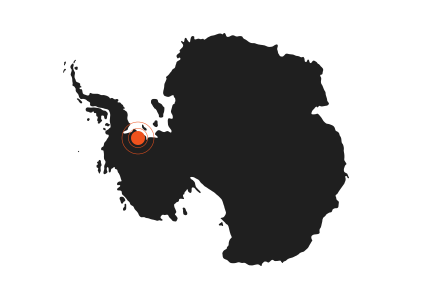
The GLASS project team is deploying a new way to “listen” to how the Antarctic ice sheet interacts with the ocean. Using a fiber-optic cable as thousands of sensors, GLASS measures small vibrations and movements that reveal how the ice sheet flows and responds to change at the grounding zone - where the ice meets the sea.

Where we went
- Field site: Constellation Inlet, West Antarctica
- Base of Operations: Union Glacier Camp [Antarctic Logistics & Expeditions / ALE]
- Initial Field Season: November 26 – December 13, 2025


Why we did it
By revealing how the ice sheet’s most vulnerable regions behave beneath the surface, GLASS helps refine models of sea-level rise and Earth’s changing climate. Data from GLASS will help improve long-term sea-level models and inform how scientists understand ice-ocean interactions in a changing climate.
The GLASS approach to sensing Earth’s most remote regions could also extend beyond our planet. A Lunar DAS system could deploy fiber-optic cables on the Moon to “listen” to its surface and subsurface, capturing seismic signals from impacts and moonquakes.
By measuring how seismic waves travel through the lunar crust and mantle, this technology could provide new insight into the Moon’s formation, thermal evolution, and ongoing tectonic processes, laying the groundwork for future planetary seismic networks.
How we did it


A laser interrogator sends pulses of light through a buried fiber-optic cable. Tiny imperfections in the fiber scatter the light back toward the interrogator. When the fiber stretches or vibrates due to ice movement, water flow underneath the ice, or seismic waves, the returning light changes slightly.
GLASS analyzes these changes to map motion along the entire cable, turning the cable into thousands of “virtual sensors” spaced every few meters.
What we found

GLASS revealed a more complex picture of the grounding zone than expected. Rather than finding evidence of seawater repeatedly intruding beneath the grounded ice as tides rise and fall, the seismic data suggest a thin layer of wet sediment beneath the ice expands and compacts with the tides.
The team also found that conditions beneath the ice vary significantly across the grounding zone, from hard rock to wet sediment. Together, these findings suggest that local conditions beneath the ice play an important role in how grounding zones respond to tides and ocean forcing.


The Team
Co-Leads:
- Professor Zhongwen Zhan[Caltech Seismological Laboratory]
- Joel Steinkraus[Jet Propulsion Laboratory]
Team:
- Chris Lefler [JPL]
- Luis Pereira da Costa [Caltech]
- Gerick Kubiak [JPL]
- Adrian Agpaoa [JPL]
- Justin Schachter [JPL]
- Soyeon Park [Caltech]
- Auden Reid-McLaughlin [Caltech]
- Tianshi Liu [Caltech]
- Qiushi Zhai [Caltech]
- Thatcher Chamberlin [MIT]
- Galen Kaip [Earthscope]
- Monica Nolasco [Caltech]
- Andy Klesh [JPL]
- Rachel Etheredge [Caltech]


